birch

birch
Trees are poems that Earth writes upon the sky. We fell them down and turn them into paper, that we may record our emptiness. ---Kahlil Gibran

Wednesday, May 16, 2012

The White House Food Initiative Vs. Central Library's Garden Project

Everyone has to eat. We've been doing it a long time. So, you would think that our philosophies about “Food” would be simple.  They are not. "Food"  (and the politics that govern it) is very complicated.  

Fears about food safety such as outbreaks of salmonella and E. Coli have led Congress to consider passing a bill which will allow federal agencies the authority to recall tainted products if a manufacturer refuses. I don’t understand why this is controversial? It seems like common sense to me.  Currently, there are 15 federal agencies that oversee food and drug inspections.
---
Animal and Plant Health Inspection Service - Protects the health and value of U.S. agricultural resources (e.g., animals and plants).
Grain Inspection, Packers and Stockyards Administration - Establishes quality standards, inspection procedures and marketing of grain and other related products.
Agricultural Marketing Service (AMS) - Establishes quality and condition standards for dairy, fruit, vegetable, livestock, meat, poultry, and egg products. (Has no statutory authority.)
Agricultural Research Service - Conducts food safety research.
Economic Research Service - Provides analyses of the economic issues affecting the safety of the U.S. food supply.
National Agricultural Statistics Service - Provides statistical data, including agricultural chemical usage data, related to the safety of the food supply.
Cooperative State Research, Education and Extension Service - Supports food safety research, education, and extension programs in the land-grant university system and other partner organizations.
Food and Drug Administration (FDA) - Inspects all domestic and imported food products except meat, poultry, or processed egg products.
Centers for Disease Control and Prevention (CDC) - Protects the nation's public health, including foodborne illness surveillance.
National Marine Fisheries Service - Provides voluntary, fee-for-service examinations of seafood for safety and quality.
Environmental Protection Agency - Regulates the use of pesticides and maximum allowable residue levels on food commodities and animal feed.
Alcohol and Tobacco Tax and Trade Bureau - Enforces laws covering the production, use, and distribution of alcoholic beverages.
Department of Homeland Security - Coordinates agencies’ food security activities.
Federal Trade Commission - Prohibits false advertisements for food.


We can spend lots of money to teach people about the importance of a healthy diet, but we can’t tell them what to eat or where to buy it.  These are personal decisions guided (often as not) by availability and cost more than by our personal preferences. If you are poor, it is harder to get access to good food at an affordable price.

Michelle Obama wants to change our national food policies to help with this.  She has appeared at soup kitchens and community centers to talk about the importance of a healthy diet. She has visited schools seeking to improve their lunch menus.  And, to increase people’s access to fresh fruits and vegetables, she has promoted the local-food movement. 

Here at Chesapeake Central Library we are trying in our own way to foster some of the same ideas. We have partnered with Plant-A-Row and the Chesapeake Agriculture Department  to start a small garden behind our Children’s Department .  Library programs teaching children about seeds, gardens and food are being organized.  So far, we have made pots for our plants out of recycled newspapers and planted beans. 

This summer, school children came to the First Lady’s Garden to help plant (and later harvest) food.  The intent was to show children the step-by-step process of how food gets to the table.  This is something that many children who live in the city don’t know.  Don’t vegetables come in cans?

Even some children who live outside urban areas may not know much about how food is grown.  I remember years ago we bought our little nephew a bag of hot roasted peanuts at a sporting event and after a few minutes he broke a shell open and exclaimed excitedly, “ Hey! There’s peanuts in here!”  He was so surprised. (The only peanuts he had ever seen were already shelled, salted and in a cellophane wrapper.)

Here at Central Library, we have taken some wooden pallets from our loading dock and repurposed  them to create “raised planting beds” outside our Children’s area.  We’ve stapled landscaping cloth to the bottom and sides and filled the top with potting soil and then laid them horizontal on the patio. Ta Da! A place to grow food when you can't dig!  Apartment dwellers with small balconies or outdoor space could do the same.

We are in the process of planting these flats with beans, peas, onions, lettuce and radishes. We have tomatoes in ceramic pots, sunflowers planted against the brick wall and a selection of herbs and flowers to be planted in two vertical pallets.

If our Garden Project takes off here -as we hope it will-we envision a meandering walkway around the building with pockets of edible plants scattered among the bushes and flowers. In fact, plans have already been drawn up.  (As always with new ideas, however, it is the practical matter of funding that will or will not ensure it's success.) Wish us luck.
Because having great food isn’t much use if you don’t know how to cook it, part of the White House plan is to also inspire families to cook.  By working with Brainfood, a non-profit organization that helps young people build life skills and promotes healthy living,  they are using food as a teaching tool to show people how to grow and cook food.

While I can’t say I really “enjoy” cooking all the time, I am old enough to have grown up during a time and place when there wasn’t any other option.  If you wanted to eat, you had to cook it yourself.  So, I learned early and have just considered it to be part of life.  Apparently, there are a lot of people who don’t cook at all!  (And I thought it was only my husband.)

I am hoping that the food gathered from our garden will not only feed people, but will also spawn some library programs for teens on how to cook, for adults on how to can produce,  for everyone how to eat healthy and promote the idea of food sovereignty for everyone.

Perhaps we can also form some new partnerships with people and organizations who are interested in reforming the way agriculture is subsidized, changing regulations to improve the environment, raising nutritional standards in public schools or better food labeling in the markets.  It's amazing the ideas that can be grown in a garden, isn't it?

Did you know that just learning how to cook food caused a big jump in human intellect 150,000 years ago?   Cooking breaks down fibers in foods and sends nutrients to the brain faster because less energy is required to digest it. This freed up calories to feed our brains.

If we all started growing some of our own food, and/or eating healthy locally-grown products, just think of the increase to our brain power and all the things we could accomplish! Maybe "Food" isn't supposed to be as complicated as we have made it after all?
 WHEN THE TIME'S TOXINS
by Christian Wiman


When the time's toxins
have seeped into every cell

and like a salted plot
from which all rain, all green are gone

I and life are leached
of meaning

somehow a seed
of belief

sprouts the instant
I acknowledge it.

Little weedy hardy would-be
greeness

tugged upward
by light

while deep within
roots like talons

are taking hold again
of this our only earth.


Wednesday, April 11, 2012

Hunger Games

Okay, when you saw the title above you probably assumed that I was going to talk about the latest hit movie "The Hunger Games".  Sorry, I'm not. Not really. Actually, I haven't seen the movie yet, but I HAVE read the YA series by Suzanne Collins that the movie is made from.  (I work at the library, which means you are "required" to read the novel before you see the movie if you don't want to be subjected to all kinds of ridicule.)

The book follows Katniss Everdeen, a 16 year old girl who lives in the post-apocalyptic world of North America, now called Panem. Panem has been split into 12 districts which are controlled by the Capitol. As punishment for a previous rebellion, each district must send a boy and a girl to participate in an annual televised event in which contestants are forced to kill each other until there is only one survivor.
Here are two post-apocalyptic survival books available for checkout. (Just in case)
By United State Department of the Army

The theme of the book is poverty, oppression, hunger and survival. Pretty grim topics, but for some people these are not fictional issues. They exist here and now.

This is just my opinion

I've been thinking about the  "Hunger" part lately.  Not the "wondering what to fix for supper" kind of hunger, but what it would be like to really BE hungry. (The kind of hunger that I, thankfully, have never known. )  Maybe it's because the Chesapeake Public Library system is currently hosting our annual "Food For Fines" event, where library fines are waived for patrons bringing in food items for donation to Chesapeake food pantries.

Do a good deed and all is forgiven. Libraries dispense absolution?  Yes, but this small sacrament alone will not solve the problem of hunger. More needs to be done.


Recently, I was part of a panel which discussed a library partnership with the Chesapeake Agriculture Department and the Plant-A-Row program. (See Links)  June through September every year the excess produce grown by Chesapeake residents on their own land can be donated to the city's hungry through this group.  This is an easy way for those who have more than they need to help those who need more than they have.

As you can see from the linked calendar, however, Seasonal Produce Calendar people cannot survive on the leftovers from local gardens alone.  Plans are in the works at Central to provide storytimes and workshops centering around gardening and food production. We envision programs that will teach patrons about beekeeping, edible landscaping, butterflies, vermiculture, and seed saving techniques.

Meanwhile, the library has lots of free information available on these topics and many more.All you need is your library card.

EDIBLE LANDSCAPING BOOKS
Eat Your Yard by Nan Chase
Your Eco-friendly Yard by Tom Girolamo
Front Yard Gardens by Liz Primeau
Grow great grub by Gayla Trail
Garden Anywhere by Alys Fowler
 The Small Budget Gardener by Maureen Gilmer

Though many could surely benefit from having the knowledge needed to grow their own food, some do not have the space needed or lack the ability to maintain a garden. What we need are some community gardens where the spaces are tended collectively by one group - or else allotments, which are parcels of land made available to individuals or families. Many European countries use these systems successfully.

Hunger is a result of poverty, but poverty has many causes. The best cure for poverty is work. Right now, many people are out of work. Either they cannot find a job or they had one and lost it due to the economy.  It's hard to keep food on the table when you don't work. Chesapeake Public Library offers help in this indirectly by assisting patrons in their job search by providing free internet access, offering classes on how to write a resume, and updates job skills by teaching basic computer classes in Word and Excel. (See Video Link)
 Job Help at the Library

Think a minute. Donate.

"35 million people in the U.S. are hungry or don't know where their next meal is coming from, and 13 million of them are children. If another country were doing this to our children, we'd be at war."
-- Jeff Bridges                                            

 "God comes to the hungry in the form of food" --Mahatma Gandhi

 Hunger.  Is it REAL or NOT REAL?  
(Please read sidebar link Dick Gregory's "Shame")
May the odds be ever in your favor.


P.S.   from an email I received:  
How To Plant Your Garden
First, you come to the garden alone, while the dew is still on the roses.

For the garden of your daily living, plant three rows of peas.
1.  Peace of mind
2.  Peace of heart
3.  Peace of soul

Next plant four rows of squash.
1.  Squash gossip
2.  Squash indifference
3.  Squash grumbling
4.  Squash selfishness

Plant four rows of lettuce.
1.  Lettuce be faithful
2.  Lettuce be kind
3.  Lettuce be patient
4.  Lettuce really love one another

No garden should be without turnips.
1.  Turnip for meetings
2.  Turnip for service
3.  Turnip to help one another

To conclude, you must have thyme.
1.  Thyme for God
2.  Thyme for each other
3.  Thyme for family
4.  Thyme for friends

Water freely with patience, cultivate with love and hope that there is much fruit in your garden because you always reap what you sow.   

Monday, February 20, 2012

Life Recycled

It's a rare sunny day in February.  I'm sitting out here on my deck - a cup of hot tea and my little dog beside me. An older gentleman, he has not been feeling very well lately.  I'm hoping the sun on his skin, the sounds of birds in the trees and the light breeze which keeps his nose twitching will be a tonic to him - as it is to me.

I'll probably be scraping ice off my windshield before heading into work Tuesday, but right now it sure feels like spring!  The inconsistent weather here in Tidewater has confused my daffodils into blooming and I'm almost tempted to plow up a piece of ground and plant something.  Maybe peas.

Yet, I know that each year has a pattern to follow and the seasons cannot be rushed.  Spring will always follow Winter.  This is the time of year when gardeners pore over seed catalogs and "plant on paper". You may have noticed that our winters seem milder lately? That idea can now be confirmed.  The color-coded map of planting zones has been updated by the United States Department of Agriculture.
It shows milder temperatures overall and has placed some areas of the United States in warmer zones.  I'd say that is proof positive that our climate is changing, wouldn't you? Someone should tell Rick Santorum.

However, right now I'm not too concerned about global changes . I'm concentrating on the changes in my life.  I have a daughter who is about to give birth,:-) a son-in-law who will be leaving soon on a 6-month cruise with the U.S. Navy, a husband who is facing surgery with a long recovery time, and a little dog who is (I fear) dying. I'm focused locally. Winter, for me, may continue a while longer - though the sun will shine in places.

Life, I've found, is the ultimate recycle.  Everything we experience as a child, we view again through adult eyes when we have children of our own.  Life began before we arrived, but it also stretches out in front of us to a place and time we will never see.  Yet, the path is not a straight line. It is a twisting road that doubles back on itself unexpectedly.

I have a clear, happy memory of sitting on my Mammaw's back porch in Texas shelling black-eyed peas. She was sitting in a chair with a bowl in her lap, and I was at her feet with my own little bowl "helping".  I was about five. I recall looking out over the back yard at the clothes hung on the line and the chickens scratching in the grass for bugs. I could see the two tall pine trees in the middle of the fenced cow pasture beyond.  Those trees were the boundary I was not allowed to go past. Which was okay with me, because they were so far away that when I was walking toward them, I had to turn around and look back at the house to make sure I could still see it.

When I was seven, my family moved to Utah and I only got to see my Mammaw on summer vacations. The trees got closer and closer to the house each year.

Later, after my Mammaw died and my parents retired, they bought her place from the other siblings and moved back there.  They raised chickens and had a garden. When we visited them on summer vacations, our daughter gathered eggs with my Mother and we all shelled black-eyed peas on the back porch.

My father, by that time, had difficulty walking and so had a golf cart that he would load with fishing gear and take my daughter to the pond behind the two tall pine trees. He stocked the pond with catfish and went out there every day to feed them bread.  To catch one, all my daughter had to do was bait her hook with bread.

My Parents

My daughter is grown and my parents are both dead now. The property in Texas has passed out of our family. I have a house here in Virginia with a deck overlooking the garden and the barn beyond it.  No chickens - yet.  But, I expect in about four or five years to be shelling peas with my granddaughter and I'll tell her not to go beyond the apple tree unless she is going to the lake behind the barn to fish with Grandpa (my husband).
 ---  
My Mammaw never imagined her daughter (my mother) would move away to Utah to raise her family. She  never knew my mother would return home to live out her life in the place she started from. My Mother never imagined I'd move to Virginia and live my life here. And, because my son-in-law is in the Navy, I don't know how long my daughter and their future child will be here near us. And, I certainly have no idea where this little granddaughter will wind up, or what her life will be.

All I can do is hope that one day she will look back at her childhood and have some clear, happy memory she shared with me...even if it's only shelling peas. Her life will go forward and my life will be part of the past. She will, of course, have no memory of my Mother or of my Mammaw. Those stories will end with me. Though she will never know them, they existed and were important ---and I have to believe that something of them remains somewhere.

One day my granddaughter will have a child and my child will be the grandmother!  I will be long dead. I will never know what becomes of them, but I'm hoping that they find happiness in their life, as I have in mine. 

 " From the day we arrive on the planet
And, blinking, step into the sun
There's more to see than can ever be seen
More to do than can ever be done
There's far too much to take in here
More to find than can ever be found
But the sun rolling high
Through the sapphire sky
Keeps great and small on the endless round
It's the Circle of Life
And it moves us all
Through despair and hope
Through faith and love
Till we find our place
On the path unwinding
In the Circle
The Circle of Life."

Thursday, January 19, 2012

You ought to see my Cindy

When people talk about recycling products, reusing materials, reducing clutter and repairing items they often like to link these practices with the idea that we are “saving the planet”.  While it is true that doing these things helps with the problem of trash disposal, I believe that the positive impact of these actions upon our environment is actually pretty small.

What is important about doing these things is that it changes our self-centered mindset. By actively thinking about other ways to use something before sending it to the landfill, people begin to see “the environment” as something directly affected by their action or inaction. They begin to realize that not only are we a part of this world, but that it is a part of us too. How we treat it reflects upon us as a species.

The world is more than just a resource to be used by people, but those resources are not there just to be protected from people either. There is a balance. When we use something of the Earth, we need to make sure that we take only what we need and no more.  And, that in doing so, nothing else is harmed.  Furthermore, we need to give something back in return. 

We need lumber to build ourselves a house, but we don’t have to cut down the whole forest. We need food to eat, but how essential is it to fill every vacant lot with a McDonalds? We have just as much right to be here as all the other animals do.  Unlike the other animals, however, we are supposed to be intelligent.  We have choice, not instinct.

If we wanted to, we could make intelligent choices – not selfish ones.  We could see that as important as we think humans are, the most skillful painting or technically perfect photograph of a tree is nothing compared to the beauty of the actual tree itself. 

We have a lovely pink dogwood that hangs over our backyard deck.  When my daughter was three, we were sitting outside underneath the branches of this tree when she looked up and asked me, “Mommy, what is this tree’s name?” I told her that it was a dogwood, but that’s not what she wanted to know.  She wanted to know the “name” of this particular tree!

When I told her “I don’t know”, she said, “She’s so pretty, I’m going to call her Cindy!” Ever since then, our family has referred to this tree as “Cindy”.  As in: “Oh, look there’s a little yellow bird sitting on Cindy!” or “Let’s take our lunch outside and sit under Cindy!” 

It wasn’t just a tree to her; it was an individual worthy of a name. I do realize that she was just three years old and didn’t have the understanding of the world the way an adult does, but wouldn’t it be great if we all valued each plant and each animal as deserving as much right to exist as we do?

We dig in the earth and sow the seeds. With the help of sun and rain, the seeds grow into plants. The plants feed us and give us air. Let’s use what we have carefully. This planet is our salvation, not the other way around.


Way Out Where
I want to go way out where
the sky is green where I can tear up
certainty and make irregularity
out of string and strip
the departed the muted the rare
good primary labor
the sort that does not leave
spots or streaks or dust or bits of bone
just the broken subtlety
of found cloth hard to come by
fields of yellow flower and wild thyme
and salt and pepper ‘case the witches come
where you can piece yourself
get the dust out and winter burn
rise up in the morning time
every stuff of your own all there no pattern
just over the hills a scattering
of fog and white pine and the young
mother singing to her baby
lulla lulla
rain do come down my beauty
it do come down—
- Eva Hooker


Tuesday, December 20, 2011

Slogans, Definitions and Games

2011 is almost at an end! I thought I’d borrow a catchy slogan about going green that would define the ideas this blog has tried to impart this past year.


There is the very simple - “Recycling works!”,
the polished - “Recycle today for a better tomorrow”,
the overly-rhyming - “When you refuse to reuse it’s the Earth you abuse”,
and the almost-rhyming -  Paper, bottles, cans, plastic…recycle them all, it's fantastic!”.
There is the lazy slogan - “Eat, sleep, recycle”,
the reproachful -  Don't trash our future: Recycle”,
the smug -  It's easy being green”,
and  the silly.
“I pity the fool who don't recycle”
There is the trying-too-hard-to-be-clever “Waste is a terrible thing to mind-recycle“.  And the hoarder’s mantra -  “When there is doubt, don't throw it out!”

My personal favorite is  - “Recyclers do it over and over again”, but that’s kind of crass.  So is my second choice -  “Once is not enough, recycle”. 

I’m afraid to examine what that says about me! So, let’s just forget the slogan and wipe out waste by following the four R’s as below:
Reduce - Decrease the amount of waste you produce by purchasing fewer products and making sure that those you do buy are long-lasting and have merit.
•Reuse – Donate or sell items you no longer need or use and re-purpose stuff you already have on hand to eliminate waste.
•Recycle - Plastic, paper, glass and metal materials can be separated and processed to be used again.
•Repair – Fix broken items instead of purchasing replacements.

If you still have stuff leftover, then you can do what I like to do:
Make Art (or something useful) from Recycled Materials
PAPER
magazines
                                               from http://greenupgrader.com
newspapers

PLASTIC
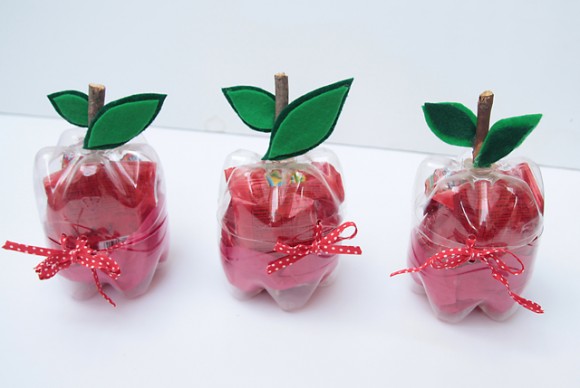
soda bottles
                                          from  www.dollarstorecrafts.com

credit cards
                                          from www.recycledcrafts.craftgossip.com

GLASS
 pickle jars
                                          from www.housetohome.co.uk

  broken glass earrings
                                                  from www.marthastewart.com

METAL
 globes
           from http://consignmentphinds.blogspot.com
spoons
                                          from http://storageandglee.blogspot.com

TEXTILES
zipper
into a beautiful brooch

fabric scraps
                                             from http://kimboscrafts.blogspot.com

OTHER
Truely bizarre
                                                        Recycled "Art"

 Why would you?
                                          something "useful" ?


RECYCLING GAMES
This is an online game from the EPA where you are city manager of "Dump Town" and you have to solve the city's pollution problems.
Energy Quest Booklet
This is a 26-page PDF printable booklet from California's "Energy Quest" with puzzles, word games, and crafts.
National Geographic Recycle Roundup
Online game where you have to help "Gus, the gorilla" clean up the park.
Action for Nature
Two online flash games called "Clean Up" and "Recycle".
This website offers an online quiz, PDF coloring book, Activity Book and Bingo game.
From Australia’s Sustain Ability International Party
 
Have fun exploring the crafts links and playing the games! 
RECYCLE (over and over because once is not enough)

Monday, November 14, 2011

Don’t Play with Your Food

Before I even open up this topic, I have to admit that I am prejudiced.
I DO NOT accept that technology always equals progress. If you think it does, then I'm asking you,“WHAT exactly are we progressing toward?”


JUST BECAUSE WE CAN…SHOULD WE?

By 2050, we will need to have figured out a way to feed nine billion people, found a solution to protect our drinking water from pollution, and -almost certainly- adjust to some kind of drastic climate change. All this at the same time, and in less than 40 years!

Given this alarming set of problems, let’s just limit ourselves to the first challenge and ask “What is the quickest, least expensive way to develop higher yields of drought-, flood- and pest-resistant crops?” How are we going to feed that many people?

Some people think that genetically engineered (GE) crops are the answer. However, classical breeding programs (the system that has supported mankind since we began growing our own food) introduce new varieties just as fast as genetic engineering, and use ecologically sound methods.  GE foods are not better. Why? Because genetically engineered seeds do not increase overall crop production. Most of the “genetic engineering” that is done is just to help the seed survive being drenched with chemicals. That’s all.

Monsanto and DuPont, the two largest chemical companies in the world, are also the two largest seed companies in the world. What a coincidence! The main source of seeds for all our major crops are being patented by these two corporations. Instead of being an answer to world hunger, genetic engineering could actually be a major contributor to starvation! How?

READ THIS PART TWICE

There are now patents on genetically engineered 'terminator' seeds. These seeds are designed by biotech companies to produce a sterile seed after a single growing season! This is done to make sure that farmers cannot save the seeds to use the next planting period, but will have to buy them from corporations every season instead. Does anyone believe that the solution to world hunger is to make the crops of the world sterile?

 Seeds of Change              Terminator Seeds            Ban This Technology

JUST BECAUSE THEY CAN…SHOULD WE LET THEM?

Can you picture the starvation that would occur should these “sterility genes” escape from the engineered crops and contaminate other local crops, unintentionally sterilizing them? It would be catastrophic, since most of the world's farmers DO rely on seeds saved from one season to use in planting the next years' crop.


Facts regarding Natural Food Vs. Genetically Engineered Foods:
1. EXPENSE - Genetically engineered crops are significantly more expensive to develop.

2. CONTROL -The world's food supply will be in the hands of a few large companies.
Self-sufficient farmers will be driven off their land. (Monopolies are never good.)

3. TESTING TIME IS THE SAME - Just as in classical breeding, new GE varieties must be tested in the field for several years to ensure they perform as expected.

4. FOOD SECURITY -Will we know what we are eating?

5. POLLINATION – GMO’s (genetically modified organisms) can’t control honey bees! Insect pollination is the main way plants are propagated. Insects will move genetically modified material around, spreading it in unexpected ways and to unwanted places. The insects themselves may also be affected by the differing qualities/quantities of nectar from these plants – and in the case of honey bees – it may be passed on to us when we eat their honey!

6. DECREASED NUTRITIONAL VALUE - Brightly colored, fresh looking GE foods may actually be weeks old, with poorer nutritional value.

7. INFERIOR PROPERTIES- Plant breeders have already produced drought tolerant varieties of sorghum, corn, rice, cassava and pearl millet - all critical for poor farmers in developing countries. Meanwhile, Genetic engineering has yet to commercialize its first drought-tolerant crop.

8. BIODIVERSITY - Biotechnology will destroy biodiversity by limiting the types of foods grown – we need more kinds NOT LESS!

9. NO RECALL - Once genetically modified organisms have been introduced into the environment, they can't be called back. It’s permanent.

For Example: Researchers at Purdue University found out that the release of only a few genetically engineered fish into a large native fish population could make the original species extinct in only a few generations. Scientists at Cornell University discovered that the pollen from Bt corn could be fatal to the monarch butterfly and other beneficial insects.

10. GENE TRANSFER- Is it possible that human genes could be introduced into the food supply? ABSOLUTELY!!!!


Gene Transfer

11. HEALTH CONCERNS -Researchers at the USDA are currently experimenting with inserting human growth genes into pigs, in a Maryland project at the Belchville Agricultural Research Center. The problem? If you introduce human genes into pigs, viruses that only affect pigs could adapt to affect humans! If viruses are able to cross the species barrier, then we could have devastating worldwide epidemics in the human population!

Our ability to play with genetics gives us the power to alter our biology and radically change our environment. Forever. This kind of power should not be given to -or wielded by- those seeking profits. That we allow this power to be unregulated is unbelievable, but true.

If we don't take a stand now, our future is already set.

Check these links for library books available


Wednesday, October 19, 2011

Can We Recycle Energy?


Nikola Tesla
 Thomas Edison gets the credit for discovering the light bulb, but it was his former assistant, Nikola Tesla, who made the breakthrough in alternating-current technology that now provides electrical power to us.

When Tesla began working for him, Edison had just invented the electric light bulb, but he needed a system to distribute the electricity. Edison had designed a DC (direct current) system, but he couldn't make it work right and offered $50,000.00 to anyone could fix the machine! When Tesla solved the problem, Edison took back the offer saying that “it was just a joke.” So,Tesla quit. Edison immediately took out the patent for the (now working) direct current motor in his own name!

In school, we were taught that Edison was some kind of genius, but from what I’ve been reading, it seems to me that Edison was really a greedy, opportunist who became rich by claiming the inventions of his employees, cheating them out of the profits due them, and then vindictively smearing those who stood up to him.

Since Tesla knew about the problems with DC electrical power, after he left Edison he came up with a better idea – Alternating Current or AC.  Today, everything runs on the A/C system.

Did Tesla get rich off this idea and get his revenge on Edison? Nope. Unfortunately, Tesla was working for George Westinghouse when he came up with this invention. Just as Edison had done, Mr. Westinghouse provided the funding for the inventor’s research and then stole the patent for himself.

Men like Thomas Edison and George Westinghouse have always been around to interfere with the development of something new or something better. Why? If someone is financially invested in the status quo, there is no incentive for them to embrace any kind of change. It’s all about politics and money. That’s why the use of solar power still hasn’t kicked in.

Big Fossil Fuel Industries lobby to stop any subsidies for alternate energy because they are making huge profits from coal and oil. They’d rather drill in Alaska, run pipelines under the river in Yellowstone and spill oil in the Gulf of Mexico,even though the most abundant resource available to us is the Sun – because sunlight is free! The cost is in manufacturing the solar cells.

Without the government subsidies available to fund the production of solar cells, we are forced to depend upon coal and oil. Legislation follows the money. Most people can figure costs, but few can measure values.

After Tesla left Westinghouse he came up with a lot of other great ideas. He solved problems in engineering, physics, steam turbines, magnetism and robotics. He used the power from Niagara Falls to make the first hydroelectric power plant!  He created a 130-foot long bolt of lightning in his lab and wirelessly lit 200 light bulbs from a power source 26 miles away. He even came up with a way to clean the human body of germs using electricity!  But, unfortunately, he kept most of the designs for his inventions in his head. After his earlier experiences with sponsors do you blame him?

One of his ideas was for something he called “Free Energy”. He thought that a generator could pull electrostatic energy from the Earth’s atmosphere, which could then be broadcast to other locations through the ground.

“We are whirling through endless space, with an inconceivable speed, all around everything is spinning, everything is moving, everywhere there is energy. There must be some way of availing ourselves of this energy more directly. Then, with the light obtained from the medium, with the power derived from it, with every form of energy obtained without effort, from the store forever inexhaustible, humanity will advance with giant strides. The mere contemplation of these magnificent possibilities expand our minds, strengthens our hopes and fills our hearts with supreme delight.”
- Nikola Tesla

If true, this invention could have produced a never-ending supply of power for the entire planet! However, when he died in 1943, the FBI confiscated all of Tesla’s paperwork. I guess we may never know, but the idea and the possibility is still ...exciting.

“When the great truth accidentally revealed and experimentally confirmed is fully recognized, that this planet, with all its appalling immensity, is to electric currents virtually no more than a small metal ball and that by this fact many possibilities, each baffling imagination and of incalculable consequence, are rendered absolutely sure of accomplishment; when the first plant is inaugurated and it is shown that a telegraphic message, almost as secret and non-interferable as a thought, can be transmitted to any terrestrial distance, the sound of the human voice, with all its intonations and inflections, faithfully and instantly reproduced at any other point of the globe, the energy of a waterfall made available for supplying light, heat or motive power, anywhere — on sea, or land, or high in the air — humanity will be like an ant heap stirred up with a stick: See the excitement coming!”
- Nikola Tesla

Links to Library Books Available on This Subject:


The Invention of Everything Else by Samantha Hunt

Empires of Light: Edison, Tesla, Westinghouse and the race to electrify the world by Jill Jonnes

The Tesla Papers by Nikola Tesla

Wizard: the life and times of Nikola Tesla:biography of a genius by Marc J. Seifer


Tuesday, September 27, 2011

Pandora's Box

I was recently lured into watching the latest disaster movie "Contagion" because Matt Damon was starring in it. This is a story about a future global pandemic. As these types of movies go, it was well done,entertaining and fairly accurate. However, even cute Matt Damon won't tempt me into seeing it twice. I mean, what would be the point? I figure that ( just like the movie) by the time the World Health Organization issues a statement about an upcoming plague, it will be too late. Nobody opens an umbrella until after it has begun to rain. If you are already wet, what good is the umbrella?


We have had enough stuff happening locally lately - fires, earthquakes and hurricanes - to deal with.  I  know that the possibility of widespread infectious disease is certainly real, but we shouldn't waste our time worrying about it. When they tell you a hurricane is coming, you stock up on supplies and prepare yourself as best you can. You won't get a warning before an earthquake strikes. The only thing you have any real control over is yourself. (And sometimes, even that is questionable!)

It's a dangerous, unpredictable world. But, I'm not going to fret about possible future events that I have no control over. Neither should you! Besides, most of the disasters predicted have never actually happened.  Or, if they did, things didn't turn out like they said it would. Remember these?
CLICK ON THE LINKS

While all these are of some concern, I think a greater immediate danger to us is global terrorism and an unstable world economy.   These are things that we can solve.

While I can't pretend to be an expert in politics, my view of terrorism is that it exists simply because people are trying to fix something that they perceive to be an injustice, and they can't see any other way to bring that change about except by violent actions.  

Al Qaeda - wants to remove current leadership and foreign influence in Arab countries in order to promote their version of Islam.

IRA - wants to create a unified Ireland under Irish rule, not British.

Animal  Liberation Front  (Associated with PETA) - wants to end animal abuse.

All these groups have what they think are legitimate causes. The methods they use to promote those causes is what determines how legitimate the rest of the world feels their claims to be.  Their success utimately depends upon support from others, and you can't gain sympathy for your cause by following a negative path.  As Mahatma Gandhi said, "An eye for an eye makes the whole world blind." 

We have an unstable economy because humans are basically greedy.  We take what we want/do what we want, with no thought of the consequences. We pollute the air, poison the land and the water, and treat each other with disdain. We want wealth without work, we practice commerce without morality, science without humanity, and politics without principles.

The difference between what we do, and what we are able to do would be enough to solve most problems. We have to be that change we want to see in the world.  Peace, to have meaning, can't just be a word.  It must be translated into food, shelter, health care, education, freedom and human dignity. If you want peace, you must work for justice. 

There is no way to peace, peace is the way.
---
Check out these links:  BOOKS AVAILABLE AT OUR LIBRARY
The Agricultural Link: how environmental deterioration could disrupt economic progress   by Lester R. Brown

Deep Economy: the wealth of communities and the durable future by Bill McKibben

100 Ways to Save the World by Johan Tell

The End of Nature by Bill McKibben

One With Nineveh by Paul Ehrlich

Enough: staying human in an engineered age by Bill McKibben

Wild Solutions: how biodiversity is money in the bank by Andrew Beattie